
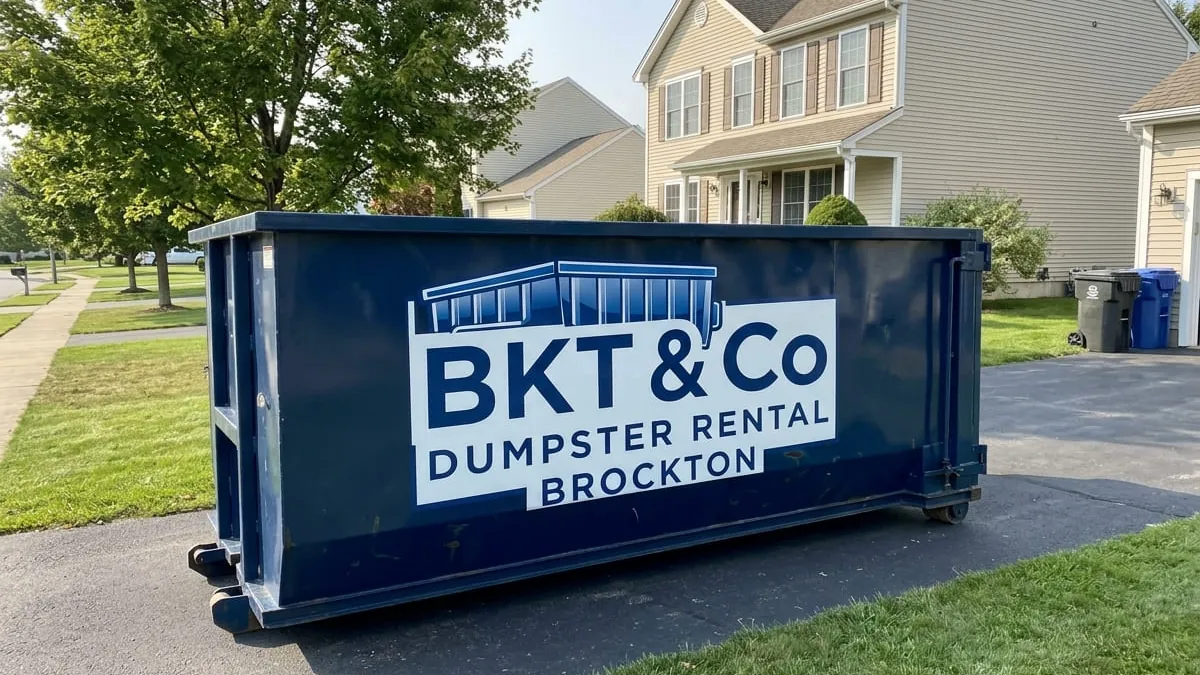
Brockton, MA · Plymouth County
Dumpster Rental in Brockton, MA — Delivered Fast, Priced Flat
10 through 40 yard roll-off dumpsters for homeowners, contractors and businesses across Brockton and the South Shore. One phone call, one flat price, and a driver who protects your driveway. Locally owned since 2011.
- Same-day & next-day delivery
- Flat rates that include disposal
- Driveway protection boards as standard
- Licensed, insured and locally owned
Licensed & insured · Flat-rate quotes · Locally owned since 2011
Why BKT & Co Dumpster Rental
The dumpster company Brockton calls back
Most people renting a dumpster are already having a stressful week. The kitchen is in pieces, the roof is half off, or a family member has passed and there is a house full of forty years to sort out. The last thing anyone needs is a hauler who quotes one price, invoices another, and drops a container across the mailbox.
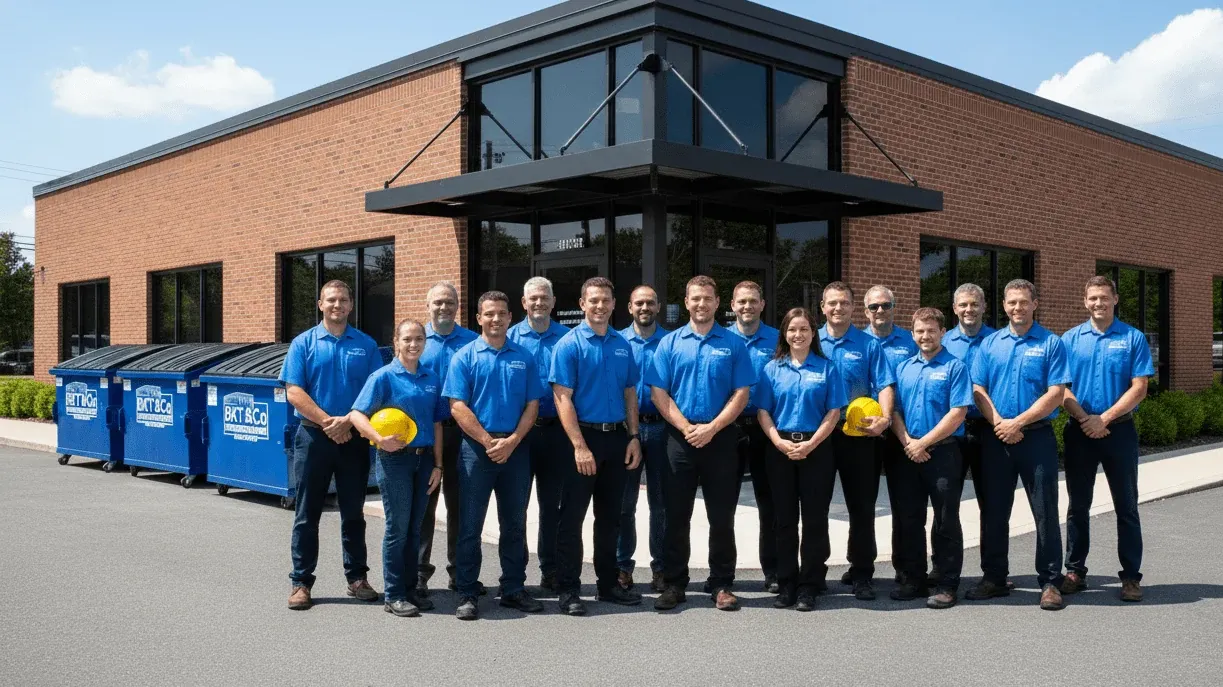
We started BKT & Co Dumpster Rental in 2011 with one truck and one rule: tell people the truth about what it costs and show up when we said we would. 15 years later that has not changed. Brendan Teixeira still answers the phone most mornings, and our drivers still walk the drop before they back in.
We run out of 1109 Montello St in the Montello district on Brockton’s north side, a short run to Route 24, which is exactly why we cover Brockton, Plymouth County and the rest of the South Shore every single day rather than routing a truck down from Boston when you need a container this afternoon. It also means we know the rulebooks apart. Massachusetts has 351 cities and towns and no county layer running solid waste, so there is no Plymouth County rulebook to fall back on — every municipality writes its own, and our neighbours are not even all in one county: Stoughton, Avon, Holbrook and Randolph sit in Norfolk, Easton, Raynham and Taunton in Bristol, and the rest with us in Plymouth. Randolph runs a drop-off at 6 Carlino Way on alternate Saturdays only, April to mid-November, with a $50 annual yard-waste permit; Whitman instead bills a flat annual charge set by its Board of Selectmen — $435 a unit in FY2026, up to three units, with buildings of four units or more left to arrange private collection. Two towns ten minutes apart with nothing in common. Over the top of all of it sits one rule that does apply everywhere: 527 CMR 1.00, Table 1.12.8.5 makes a rubbish container over six cubic yards a permitted activity issued by the head of the fire department — that is every roll-off we own — unless it is delivered and taken away inside a single business day. Past that it is street knowledge: which two-families off Belmont Street and Pleasant Street share one narrow drive between them, so the can goes at the head of it before a neighbour’s car boxes it in; which three-decker turnovers in Montello and along Main Street south toward Campello have a rear yard no truck will ever reach; which streets around Cary Hill, Bellvue Park and West Elm Street run a maple or oak limb straight across the approach; where a winter of ploughing has buried the kerb line and the last few feet of the apron until March; which downtown and Salisbury Square addresses have no drive at all; and how the Thatcher Street Smart Growth Overlay District and the transit-oriented blocks around Campello are building at a density that leaves no spare frontage.
Read more about who we are and how we got started, or jump straight to what we haul.
- Founded2011
- Container sizes10 – 40 yd³
- Typical deliverySame or next day
- Towns served18+
What we haul
Dumpster rental services in Brockton and the South Shore
Eleven container services, one flat-rate promise. Whatever the job, the price we quote on the phone is the price on your invoice.
Residential Dumpster Rental
Driveway placement for full-basement, attic, porch and shed cleanouts and remodels.
Learn more →Commercial Dumpster Rental
Containers for businesses and condominiums, which the City does not collect from at all.
Learn more →Construction Dumpster Rental
Jobsite roll-offs routed to a permitted C&D processor, with next-day swap-outs.
Learn more →Roofing Dumpster Rental
Weight-rated cans sized by squares and layers for asphalt shingle tear-offs.
Learn more →Roll-Off Dumpster Rental
10, 15, 20, 30 and 40 yard roll-offs across Brockton and the South Shore.
Learn more →Same-Day Dumpster Rental
Call before the cut-off and we can usually get a container to you this afternoon.
Learn more →Junk Removal Dumpsters
Clear a full basement, attic, porch or shed on your own schedule.
Learn more →Estate Cleanout Dumpsters
Discreet, patient container service for families clearing a lifelong home.
Learn more →Demolition Debris Removal
Containers and fast swaps for porches, decks, sheds, garages and interior gut-outs.
Learn more →Concrete & Heavy Debris
Dedicated heavy cans for concrete, brick, plaster and foundation spoil.
Learn more →Yard Waste & Brush Removal
Separate clean loads — Massachusetts has banned yard waste from disposal since 1992.
Learn more →Choose your size
Five sizes, sized for real projects
Not sure which one? Tell us what you are clearing out and roughly how much of it there is. Ninety percent of the time we can size it correctly over the phone in under two minutes. The first question here is what the debris weighs rather than how much room it takes, because plaster and lath off a two-family gut, broken concrete and brick out of a basement or a chimney, spoil from a footing dig taken down to the 48-inch frost line, and an asphalt shingle tear-off counted in squares and layers are all weight jobs long before they are volume jobs. Dense material like broken concrete, brick, block, pavers and excavation spoil wants a small can; a porch or deck tear-off, or a full clear of a three-decker in Montello — framing lumber, cabinets, insulation and trim — is the job that genuinely wants a 40, because that debris takes up enormous space and weighs comparatively little. Bear in mind that an open can catches every nor’easter and every thaw, and a load that has taken on water or snow weighs a good deal more at the scale than the same load dry, so keep it below the rails where it can be tarped.
10 Yard Dumpster
Concrete, brick, plaster, foundation spoil and wet basement contents — weight fills it long before volume.
View this size → 15yd³15 Yard Dumpster
A single room, a small tear-off, or one unit of a two-family turnover.
View this size → 20yd³20 Yard Dumpster
A full basement and attic clear-out — the New England default — or a multi-room remodel.
View this size → 30yd³30 Yard Dumpster
A whole two-family or three-decker with basement and attic, or a large remodel.
View this size → 40yd³40 Yard Dumpster
Bulky light debris only: porch framing, fencing, siding, insulation, fit-outs.
View this size →How it works
Four steps, no paperwork
- 1
Call us
Tell us the project, your address and when you want it. Two minutes on the phone and you have a flat price.
- 2
We deliver
Our driver walks the drop, lays protection boards and sets the container exactly where you want it.
- 3
You load it
Take your time within your rental window. Keep it level with the top rail and we handle the rest.
- 4
We haul it
Call or text when you are done. We pull it, sort what can be recovered and dispose of the rest properly.
Local knowledge
What makes hauling in Brockton different
Shared drives, snowbanks, low maple limbs and the fire code’s ten feet
Placement is where most of the trouble starts here, and it is rarely about the size of the box. Brockton was laid out for shoe workers who walked to the factory, not for a roll-off truck. The two-and-a-half storey, gable-roofed sidehall two-family was the standard working-class house here by the 1860s and stayed dominant through the intensive building years of 1870 to 1915, so on street after street two houses sit close together and share one narrow drive with a car already on it. The three-deckers that filled in after 1895, mostly in Montello and along Main Street running south toward Campello, hide rear yards a truck will never reach. Often the honest answer is that the can sits at the head of the drive, or on the street. From December into March the constraint is snow: ploughing banks the kerb line and the last few feet of the apron, and until that pile is moved we need a different spot. Overhead it is low maple and oak limbs, with white pine, birch and ash behind them, and then the service drop into the house. Figure on roughly 60 ft of straight approach, 10.5 ft of width and 20+ ft of clear sky for the hoist arm. If the property is a condominium, the association and its managing agent decide placement, not the city.
Then the rule national guides get wrong for this state. 527 CMR 1.00, Table 1.12.8.5 lists “rubbish containers > 6 cubic yards” as a permitted activity, with the head of the fire department as the issuing authority. Every roll-off we run, 10 through 40 yard, is over six cubic yards, so a container left overnight anywhere in Massachusetts — private driveway or public street — falls inside that rule. §1.12.8.5.1 exempts only a container delivered and removed within a single business day, and §1.12.8.5.2 requires every container to be marked with the name and telephone number of the company that can be reached in an emergency, which ours are. Massachusetts departments enforce the NFPA 1 distances: at least 10 feet from combustible walls, openings and overhangs — not the 5 feet the International Fire Code uses in most other states — not within 20 feet of an intersection, not within 10 feet of a hydrant, nothing under a fire escape or across an egress, and where a box sits against a building, the top of it at least 5 feet below any window. Ring Brockton Fire Prevention on 508-583-2933, Office of the Fire Chief, 560 West Street, and ask how they want it handled at your address. For the public way, the City publishes no container permit at all: the DPW’s published permits are the Street Opening Permit and the Public Works Construction License, which cover openings and driveway cuts rather than obstructions, so call DPW Engineering on 508-580-7139 before you plan a street placement, and do not let anyone sell you a permit name that does not exist. Before anything gets dug — footings, a fence line, a stump, an oil tank — call Dig Safe on 811 or 888-344-7233, the one-call centre under M.G.L. c.82 §40, enforced by the DPU Pipeline Safety Division on (617) 305-3537. Tell us the cross streets and we will tell you where the can goes, or see the permit and placement guide.
Full basements at a 48-inch frost line, and the volume that comes with them
The single fact that separates a Brockton job from one in a warm-weather market is the frost line: 780 CMR 51.00, Table R301.2 sets it at 48 inches, statewide. Footings have to reach four feet whatever you are building, and once an excavator is that deep a full basement costs very little more, which is why pre-war New England housing is essentially all full-basement. That has two consequences for us. A foundation dig, a bulkhead replacement or a set of new deck posts produces far more spoil than anyone expects. And a cleanout here has a whole extra floor in it: the basement and the attic are the cleanout, and sizing guides written for slab markets assume neither, so they get the first question wrong. Spring is when it shows. The frost comes out of the ground, water finds the basement, and the boxes that have been stacked down there since the 1980s come up the bulkhead stairs wet and far heavier than they went down. February through April the other driver is the ice dam: Massachusetts answers yes to the ice-formation criterion in Table R301.2, so code section R905.1.2 requires an ice barrier under shingles, and the work that follows a hard winter is re-roofing, ceiling and insulation tear-out and attic air-sealing. Watch the National Weather Service through the winter — the office that covers us is at Norton, about a dozen miles away.
The housing is older than most people assume and it is not what general knowledge says. The Massachusetts Historical Commission’s 1981 survey is clear that Brockton is more a two-family city than a pure triple-decker city: the gable-roofed sidehall two-family was standard from the 1860s, 1870 to 1915 was the most intensive residential construction the city ever saw, and three-deckers proliferated only after 1895, particularly in Montello and along Main Street south to Campello. Inside those houses expect plaster and lath rather than drywall, asbestos pipe insulation on old steam and hot-water lines, and knob-and-tube wiring — widespread enough that Mass Save pays to have it verified and rewired before a house is insulated, alongside asbestos and vermiculite removal. Houses of this era were commonly balloon-framed, which is worth checking before demolition because of the uninterrupted stud cavities. Heating oil tanks are a live issue in these basements: Brockton Fire issues the FP-292 Tank Removal Permit with published inspection fees of $55 residential aboveground and $100 residential underground, and a spill of more than 10 gallons has to be reported, first call to the fire department. On asbestos, MassDEP requires a licensed inspector to survey a building for suspect material before demolition or renovation under 310 CMR 7.15, and the separate demolition notification under 310 CMR 7.09, form AQ 06, runs 10 working days, is exempt under 20 dwelling units and costs $100; asbestos contractors are licensed by the Department of Labor Standards under 454 CMR 28.00. Pre-1978 housing is the lead trigger, with the Massachusetts Lead Law sitting on top of the federal RRP rule and CLPPP on (800) 532-9571. And we cannot take asbestos-containing material in any container. See our notes on basement and attic cleanouts and two-family and three-decker turnovers, and confirm current requirements with the agency before you start.
The longest ban list in the country, and what cannot go in the box
Massachusetts keeps more material out of disposal than almost any other state, and the rule is 310 CMR 19.017: “No person shall dispose, transfer for disposal, or contract for disposal of the restricted material except in accordance with the restriction established in the table.” Note transfer for disposal — the ban bites at the transfer station, not only at the landfill. The list has been growing since 1990: leaves (1991), yard waste (1992), white goods, whole tires from landfills, glass, metal and plastic containers, recyclable paper and cardboard, cathode ray tubes (2000), asphalt pavement, brick and concrete (2006), ferrous and non-ferrous metal (2006), treated and untreated wood (2006, from landfills only — a municipal waste combustor may still take it), clean gypsum wallboard (2011), and, since 1 November 2022, mattresses and textiles, along with commercial organic material above half a ton a week. Two corrections worth having, because most national content gets both wrong: asphalt shingles are not banned — only asphalt pavement is, and shingles have their own recycling route — and electronics are not banned either. Only cathode ray tubes are on the table, so an old tube television is a problem and a flat panel is not.
This is why we ask what is going in the box before we quote, and it is not fussiness. MassDEP is explicit that both the generator and the hauler are subject to the waste ban requirements; facilities run random monthly load inspections and must write to the hauler and the generator inside 45 days on a failed load; and penalties reach $25,000 per violation per day for repeat or wilful ones. One mattress in a disposal load is a violation. What is entirely legal, and worth saying plainly because half the internet says otherwise, is a mixed construction and demolition load: you do not have to source-separate at the job site. What you cannot do is send it to a hole in the ground. It goes to a permitted C&D processor working to a Minimum Performance Standard — a diversion rate of 20 percent through 2025 and 2026, rising to 25 percent by 2030 — and that is where our loads go. The one sorting instruction that really matters is clean gypsum wallboard, which has to come out before a load is transferred, so keep it separate and tell us it is there. Paint, solvents, fuel, pesticides and pool chemicals never belong in a container, and PaintCare does not operate in Massachusetts whatever a national guide tells you, so the answer here is the Brockton Recycle Depot at 300 Oak Hill Way, which takes paint and household chemicals 1 April to 31 October only, charges non-residents $8 a gallon and runs a free paint swap shed. Full detail in the Massachusetts waste ban guide and the Brockton recycling and disposal guide, and check current rules with MassDEP or RecyclingWorks Massachusetts.
Weight at one end, the kerbside cap at the other
Broken concrete, brick, block, pavers and wet excavation spoil all run around 2,400–2,800 lbs per cubic yard, so a heavy load reaches legal transport weight in a container that still looks half empty. That material belongs in a 10 yard, twice, not a 30 once — see concrete and heavy debris. The local versions are spoil out of a footing or foundation dig taken down to the 48-inch frost line, a bulkhead or a basement wall opened up, a chimney taken down to the roofline, plaster and lath off a two-family gut, a porch footing broken out and a drive apron lifted. Wet basement contents after a thaw are the quiet one: cardboard, carpet and stored paper that have soaked up groundwater weigh several times what the same pile weighed dry. Storm limb wood is the other heavy load — after a nor’easter it is green maple, oak, ash and white pine, and green hardwood sits at payload in a box that still looks half full, which is why we run it as a clean separate load — see our notes on nor’easter and storm damage cleanup. A tear-off is the same conversation from the other direction: it is counted in squares and layers rather than roof area, and on a Massachusetts roof the ice barrier required under code section R905.1.2 usually comes off with it, so get the material and the layer count before you order — see roofing dumpsters and the tear-off sizing guide.
The other half of the job is the kerb, and in Brockton the kerb gives out early. Curbside collection is contracted to Republic Services and it is capped rather than unlimited: one barrel per family unit per week, 50 lbs maximum, with anything beyond that requiring the official green Brockton pay bags at $5 per roll of four; recycle carts are $55; barrels have to be off the street by 11pm. Yard waste is seasonal and there is a gap in it — 6 July to 30 October every other week, then weekly from 3 November to 12 December, loose in barrels or in paper kraft bags only, and the City is blunt that “yard waste in plastic bags or Brockton Pay Bags will NOT be picked up” — so a spring clean-up has no kerbside route at all. Bulk items are one free per unit per week and then $20 prepaid each for a mattress or box spring, a couch or loveseat, a television or monitor. Two limits matter more than any of that. First, city collection serves only 1–5 family homes that pay the trash fee — condominiums and businesses get nothing at all. Second, in the City’s own words it does not collect construction debris or doors, and for property cleanouts, automotive parts, bathtubs, kitchen cabinets, pipes, sheetrock, tree stumps, rocks, soil and asphalt, residents “must hire private haulers”. That sentence is the roll-off market here, written by the City itself. There is no landfill and no municipal transfer station in Brockton, the Recycle Depot at 300 Oak Hill Way (Monday to Saturday, 8:30am to 3:00pm) is residents-only and takes no construction debris, and the City does not rent roll-off containers. So we load heavy over light, keep everything below the top rail where it can be tarped, bag the insulation and break the cardboard down. See yard waste removal and the Brockton recycling and disposal guide.
- 15+Years serving Plymouth County
- 18Towns in our service area
- 13In-depth local guides published
- 5Container sizes, 10 to 40 yard
What customers say
Straight talk from Brockton and the South Shore
Brendan was the only one who asked what was coming out of the basement before he quoted. Two mattresses and an old chest freezer, and he told me straight that none of it could go in the container under the state ban. He sorted the routes for both and we never had a turned-away load.
Three layers of shingle on a 1912 two-family and a crew booked for the Monday. They had a can on the drive at seven in the morning, on boards, and their driver moved it once so the arm would clear the service drop. He also flagged that the fire department wants ten feet off the building, which nobody else had mentioned.
We turn units in three buildings and the city will not touch a mattress without a fee, never mind four of them. BKT know the ban rules cold and tell us what has to come out of the load before the truck arrives. That has saved us a turned-away load more than once.
My mother had been in the same house off Pleasant Street since 1974 and we had six weeks before the closing. They set a 20 on boards and swapped it twice, and never once made us feel rushed. The driver pointed us at the Recycle Depot for the paint rather than letting us bin it.
Reviews are shown as supplied by customers. Ratings and counts shown elsewhere on this site are illustrative pending live review syndication.
Service area
Dumpster delivery across Plymouth County and the South Shore
We deliver daily from our Brockton yard. Pick your city for local placement notes, landmarks and permit guidance — or see the full service area.
Dumpster Rental FAQs
How fast can you deliver a dumpster in Brockton?
Most of the time, same day if you call before about 11am, and next morning otherwise. We run our own trucks out of 1109 Montello St in the Montello district, a short run to Route 24, so we are not waiting on a dispatcher somewhere up near Boston. In the week after a nor’easter, when every roofer and tree crew in the South Shore is booked solid, it can stretch to 48 hours, and we will tell you honestly when you call. The other predictable rushes are the spring thaw, when the frost lets go and half the two-families in Brockton are clearing a wet basement at once, and the last dry weeks of October and November before the ground freezes again. If you know your dates, book ahead and we will hold the slot.
What does a flat rate actually include?
Delivery, pickup, an agreed rental period and a set tonnage allowance with disposal included. No fuel surcharge, no environmental fee, no admin fee. The only way the number changes is if you go over the weight allowance or keep the container longer than agreed, and we tell you both limits before we deliver.
Do I need to be home for delivery or pickup?
No. Plenty of our customers text us a photo of where they want it and go to work. All we need is clear access, a spot free of cars and low branches, and permission to be on the property. If the only way in is a narrow drive shared with the two-family next door, a back yard behind a three-decker, a gate beside a detached garage or a shed, or a spot the plough has banked with snow, tell us when you book and we will schedule accordingly. If the building is a condominium, say so on the first call — the association and its managing agent govern placement there, and it is easier squared away before we roll than after. Mention low maple and oak limbs, porch roofs and the service drop as well, because the hoist arm needs the height. Say so if the house is empty, too — on an unattended job the weather is the risk, so we will talk you through keeping the load below the rails where it can be tarped, and we will time the pull so a loaded can is not sitting open through a nor’easter.
Will the dumpster damage my driveway?
We put protection boards under the wheels and rails on every residential delivery, which spreads the load instead of concentrating it on four small contact patches. The complication here is the ground rather than the concrete: with a 48-inch frost line, drives and aprons lift and drop with frost heave through the winter, and by the spring thaw older flatwork has usually cracked and stepped long before we ever arrive. We photograph the existing condition on delivery either way. Narrow shared drives, alley approaches and older or hairline-cracked concrete get extra boards, and so do the newer builds around Thatcher Street and Campello, which settle under a point load rather than scuff. On a gravel or dirt pad we are fine while it is dry, but for a day or two after a thaw or a hard rain we would rather come back than cut ruts into it. Our placement guide explains it fully.
Do I need a permit for a dumpster in Brockton?
On your own driveway you still have the fire code to think about, and this is where Massachusetts differs from almost everywhere else. 527 CMR 1.00, Table 1.12.8.5 lists rubbish containers over 6 cubic yards as a permitted activity, issued by the head of the fire department, and every roll-off is bigger than six yards, so a container left overnight is inside that rule wherever it stands. The only exemption is §1.12.8.5.1, a container delivered and removed within a single business day. Call Brockton Fire Prevention on 508-583-2933, Office of the Fire Chief at 560 West Street, and ask how they handle it for your address; we cannot quote you a Brockton permit fee because the City does not publish one. The placement rules Massachusetts departments enforce under NFPA 1 are at least 10 feet from combustible walls, openings and overhangs — not the 5 feet you will read on national sites — 20 feet clear of an intersection, 10 feet clear of a hydrant, nothing under a fire escape or blocking egress, and the top of the box at least 5 feet below any window. For the street, there is no published City of Brockton permit for placing a container in the public way; the DPW publishes a Street Opening Permit and a Public Works Construction License, which are different things, so call DPW Engineering on 508-580-7139 and ask before you plan it. Every town around us runs its own desk — Massachusetts has 351 cities and towns and no county solid-waste layer — so West Bridgewater, Stoughton, Avon and Randolph will each answer differently, and Stoughton, Avon, Holbrook and Randolph are not even in Plymouth County. If the property is a condominium, the association’s rules govern placement as well. Call Dig Safe on 811 before anything gets dug. Requirements change, so confirm with the fire department before you book — or read our permit and placement guide.
What can I not put in the dumpster?
Wet paint, solvents, motor oil, fuel, pesticides, automotive chemicals, asbestos-containing material, propane and other pressurised cylinders, lead-acid batteries, medical waste, whole tires and refrigerant appliances. On top of that, Massachusetts runs the longest disposal ban list in the country under 310 CMR 19.017, and it bites when a load is transferred as well as when it is buried: leaves, yard waste, white goods, metal, glass and plastic containers, paper and cardboard, cathode ray tubes, asphalt pavement, brick and concrete, clean gypsum wallboard, and since 1 November 2022 mattresses and textiles. One mattress will fail a load at the gate, so tell us and we will route it separately. Two things national guides get wrong: asphalt shingles are not banned, only asphalt pavement is, and electronics are not banned either — only cathode ray tubes, so an old tube television is a problem and a flat panel is not. A mixed construction load is perfectly legal as long as it goes to a permitted C&D processor rather than straight to disposal, which is where ours go, but clean gypsum wallboard has to come out before the load is transferred, so keep it separate. Leftover paint and household chemicals go to the Brockton Recycle Depot, 300 Oak Hill Way, Monday to Saturday 8:30am to 3:00pm, which takes paint and chemicals 1 April to 31 October only and runs a free paint swap shed; it is residents-only, non-residents pay $8 a gallon for paint, and it accepts no construction debris at all. PaintCare does not operate in Massachusetts, whatever a national guide says. Vegetative debris still travels best as its own clean separate load rather than mixed into a construction load. Everything else on a normal cleanout or renovation is fine. Rules do change, so ask us before it goes in.
Still not sure?
Two minutes on the phone beats twenty minutes reading. Tell us the job and we will size it, price it and book it.
(508) 436-2303Helpful Local Resources
Useful official sources for permits, disposal rules and recycling in Brockton and Plymouth County. We keep these handy because half the questions we get are really questions for one of these offices.
- City of BrocktonCurbside limits and pay bags, bulk item rules, the Recycle Depot on Oak Hill Way, and building and fire permits.
- MassDEP Waste BansThe 310 CMR 19.017 disposal bans, the C&D Minimum Performance Standard, asbestos notification and the 2030 Solid Waste Master Plan.
- RecyclingWorks MAMassDEP-funded technical guidance on separating construction and demolition materials for recycling.
- Dig SafeFree utility locates before you dig, demolish or excavate — the one-call centre for Massachusetts under M.G.L. c.82.
- Mass SavePre-weatherization incentives for removing asbestos, vermiculite and knob-and-tube wiring before insulating.
- MBTACommuter rail service to Montello, Brockton and Campello on the Fall River/New Bedford Line.
- National Weather ServiceNor’easter and winter storm forecasts and climate records for southeastern Massachusetts.
- Old Colony Planning CouncilRegional planning for Brockton and sixteen surrounding communities across Plymouth, Norfolk and Bristol counties.
Talk to a real person
Need a dumpster in Brockton today?
Tell us what you are clearing out and we will tell you the right size and the flat price to put it in your driveway. No forms, no waiting on an email — just call and we will sort it out in a couple of minutes.
Serving Brockton, Plymouth County and the South Shore · Mon–Fri 6:30am–5pm, Sat 7am–1pm